
.png?width=610&height=127&name=Up%20next%20in%20this%20series%20Part%202%20Why%20Your%20Salesforce%20Support%20Strategy%20Matters%20Coming%20%5BDATE%5D%20%E2%80%94%20check%20back%20soon%20(5).png)

Salesforce, Salesforce Tips and Tricks
Your Salesforce Org Is Growing. Is Your Data Model Keeping Up? (Clone)
June 15, 2026
Read Now.svg)

June 15, 2026
10 Minute Read
.svg)
.svg)


.png?width=396&height=33&name=Part%201%20of%204%20Salesforce%20Managed%20Services%20(1).png)
Every organization has one: a growing backlog of Salesforce requests that never seems to shrink. Feature enhancements. Bug fixes. Integrations. Reporting needs. Each item represents a real business demand, and yet most of them sit untouched for weeks, sometimes months.
Requests continue to pile up; priorities compete, and internal teams struggle to keep up. Over time, what should be a pipeline of innovation becomes a bottleneck. So how do high-performing organizations break this cycle? Increasingly, they’re turning to managed services to transform backlogs into measurable results.
The difference between stalled progress and real impact often comes down to one thing: a structured delivery model. By organizing work into four key stages (intake, triage, prioritization, and delivery), Ascend Technologies' managed services transforms scattered requests into a consistent engine for results.
The Problem with Unstructured Backlogs
Step 1: Intake – Capturing the Right Work
Step 2: Triage – Assessing Scope and Effort
Step 3: Prioritization – Focusing on What Matters Most
Step 4: Delivery – Executing with Consistency and Speed
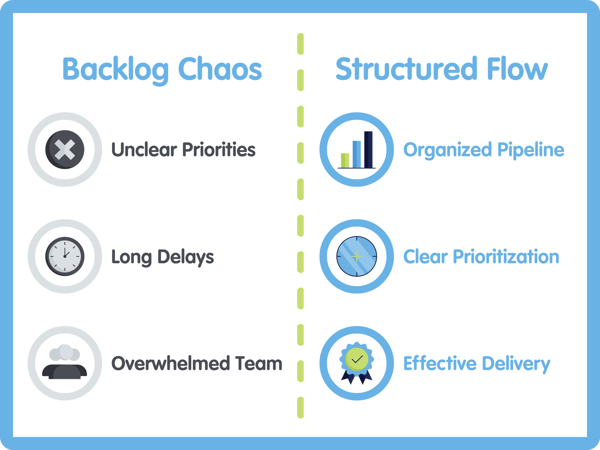 “What separates high-performing teams is structure.”
Backlogs don’t fail because of lack of effort; they fail because of lack of structure. Requests come in from multiple channels, often without enough detail or context. Teams spend more time clarifying requirements than delivering solutions, and urgent work constantly disrupts planned initiatives. Without a clear model, organizations face:
A structured approach changes everything.
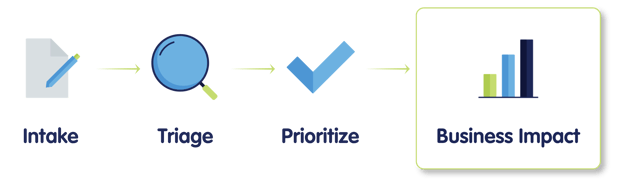
The journey from request to result begins with effective intake. This is where many organizations struggle; requests arrive incomplete, unclear, or through informal channels like emails or chat messages. Ascend’s managed services model introduces a centralized intake process:
This ensures that every request entering the backlog is actionable, reducing back-and-forth and setting the stage for efficient execution.
Once requests are captured, they need to be evaluated. Triage is where requests are reviewed for feasibility, complexity, and alignment with technical standards. During this stage:
Triage prevents poorly defined or low-value work from clogging the pipeline. It also ensures that teams aren’t surprised by hidden complexity later in the process.
Not all requests are created equal. Prioritization is where business value takes center stage. Our team works with your stakeholders to rank requests based on:
This structured prioritization shifts organizations from reactive decision-making to intentional planning. Instead of tackling whatever is loudest, teams focus on what drives the most value.
With clear priorities in place, delivery becomes more predictable and efficient. With Intake, Triage, and Prioritization already done, our delivery teams can focus entirely on execution. We run on:
The result is faster turnaround times, higher-quality outputs, and greater stakeholder confidence.
What makes this model powerful isn’t just the individual steps—it’s how they work together. Each stage builds on the last, creating a seamless flow from idea to impact.
This end-to-end structure transforms a chaotic backlog into a strategic asset.
When organizations adopt this model through managed services, the benefits are immediate and measurable:
Most importantly, work stops being just “completed” and starts delivering real outcomes—whether that’s increased efficiency, better customer experiences, or new revenue opportunities.
Salesforce managed services is an outsourced model where a dedicated partner team handles the intake, triage, prioritization, and delivery of your Salesforce requests on an ongoing basis. Rather than relying solely on internal admins or developers who are pulled in multiple directions, a managed services partner brings structured processes and dedicated capacity — so backlog items move forward consistently instead of sitting idle. The result is faster throughput, clearer priorities, and more predictable delivery.
Most organizations see meaningful improvement within the first 30–60 days. Early wins typically come from the intake and triage stages, where requests are properly scoped and redundant or low-value items are filtered out, immediately reducing the backlog volume. Delivery improvements follow as sprint cadences and SLAs take hold. The timeline can vary depending on the size and complexity of your existing backlog, but structured progress is visible quickly.
Staff augmentation adds bodies; managed services add structure. With traditional staff aug or a project-based consulting engagement, you get capacity for a defined period, but the intake, prioritization, and delivery model still depends on your internal team to manage. A managed services model owns the entire delivery lifecycle, from how requests come in to how they get completed and reported on. This means less overhead for your team, greater consistency, and a partner that's accountable for outcomes...not just hours.

Salesforce, Salesforce Tips and Tricks
June 15, 2026
Read Now

Salesforce, Salesforce Tips and Tricks
June 15, 2026
Read Now

Salesforce, Salesforce Tips and Tricks
June 15, 2026
Read Now