
Salesforce, Salesforce Tips and Tricks
How to Build an AI Governance Framework a Lean IT Team Can Run
September 24, 2026
Read Now.svg)

May 4, 2026
.svg)
.svg)



So, you’ve implemented Salesforce and officially gone live?
After months of discovery sessions, design, and user acceptance testing, your system is live, your team is trained, and it finally feels like the hard part is behind you. So naturally, it might feel like the finish line...and time to say goodbye to your consultants. Right?
Not quite.
In the first few months, everything works as expected. Fields capture the right data. Automation handles the repetitive stuff. Productivity ticks up, and confidence in the system grows. But then, quietly, things start to shift. You notice:
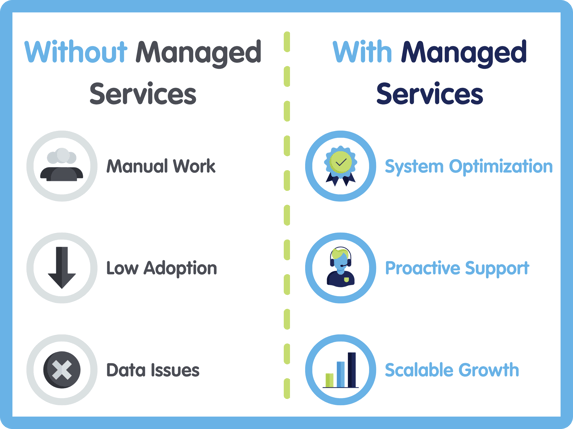
“Here’s what we typically see without the right support model in place.”
Without dedicated support, small inefficiencies quickly become bigger problems. Instead of helping close deals, Salesforce starts to feel like a barrier. User adoption drops. Trust in the system declines. And your investment begins to lose its impact.
This isn’t a failure of Salesforce; it’s a lack of ongoing care.
Your business isn’t static. As your company grows, your processes evolve. New requirements emerge. Technology advances. Without continuous optimization, even the best-built Salesforce org becomes outdated. At Ascend Technologies, we’ve seen this story play out time and time again. And it’s exactly why we believe in putting our clients first, not just during implementation, but long after go-live. For us, “client success” means:
Because a system without ongoing support isn’t just inefficient—it’s unsustainable.
Managed services offerings are designed to provide ongoing, proactive support to maintain, optimize, and evolve your Salesforce org, so you can spend more time focusing on running and growing your business.
With a flexible, monthly model at Ascend, you gain access to:
The result?
Organizations that move to a managed services model typically see operational costs drop by up to 50%...without sacrificing capability or expertise. All without the overhead of hiring a full-time, in-house team.
The bottom line? Salesforce isn’t a one-time project; it’s an ongoing journey.
Going live is a major milestone, but the real value comes from what happens next. With the right support in place, your Salesforce org becomes a powerful, evolving tool that drives growth and efficiency. Without it, even the best implementations can fall short.
In our next blog, we'll explore why having the right Salesforce support strategy matters more than most organizations realize — and what it costs when you don't. Because not all support is created equal. And choosing the wrong model is one of the most expensive mistakes a growing company can make.
.png?width=610&height=127&name=Up%20next%20in%20this%20series%20Part%202%20Why%20Your%20Salesforce%20Support%20Strategy%20Matters%20Coming%20%5BDATE%5D%20%E2%80%94%20check%20back%20soon%20(3).png)
A support ticket system is reactive — you log a problem and wait for a fix. Salesforce Managed Services is proactive. Rather than waiting for something to break, a managed services partner continuously monitors your org, identifies inefficiencies before they impact your team, and implements improvements on an ongoing basis. You also get strategic guidance for future growth, not just break-fix responses.
The best time is immediately after go-live — before small inefficiencies compound into larger problems. That said, many organizations move to managed services after noticing declining user adoption, growing backlogs of system requests, or a Salesforce org that no longer reflects how their business actually operates. If your team is working around the system rather than inside it, it's time.
Hiring a full-time senior Salesforce Administrator comes with significant overhead — salary, benefits, onboarding, and turnover risk. A managed services model gives you access to a full team of certified Salesforce experts — admins, developers, and strategic advisors — at a fraction of that cost. Organizations that switch typically see operational costs drop by up to 50% while gaining broader expertise than any single hire could provide.


Salesforce, Salesforce Tips and Tricks
September 24, 2026
Read Now

Salesforce, Salesforce Tips and Tricks
September 22, 2026
Read Now

Salesforce, Salesforce Tips and Tricks
September 17, 2026
Read Now