

Salesforce, Salesforce Clouds
Cybersecurity Awareness Month 2026: A Checklist for IT Directors Evaluating Their MSP
October 06, 2026
Read Now.svg)

August 22, 2025
.svg)
.svg)


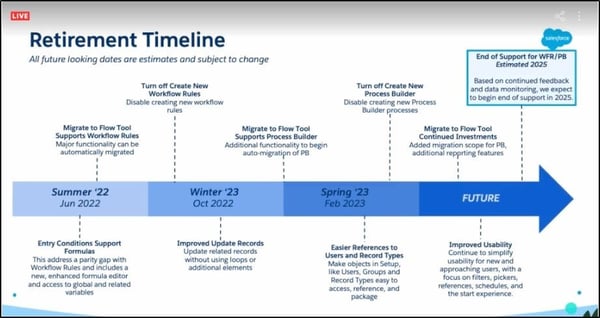
December 31, 2025. That’s when Salesforce officially ends support for Workflow Rules and Process Builder. No more updates. No more fixes. No more “we’ll patch it in the next release.”
Technically, your old automations might still function after that date… but let’s be honest—so did your old flip phone, until it didn’t. Legacy automations will become increasingly brittle, slower, and less secure over time. But here's the thing: this isn’t just a shutdown. It's an upgrade opportunity.
Salesforce Flow—and its next-level cousin, Flow Orchestration—aren’t just replacements. They're the new backbone of automation in Salesforce, giving teams the power, flexibility, and visibility they’ve been craving.
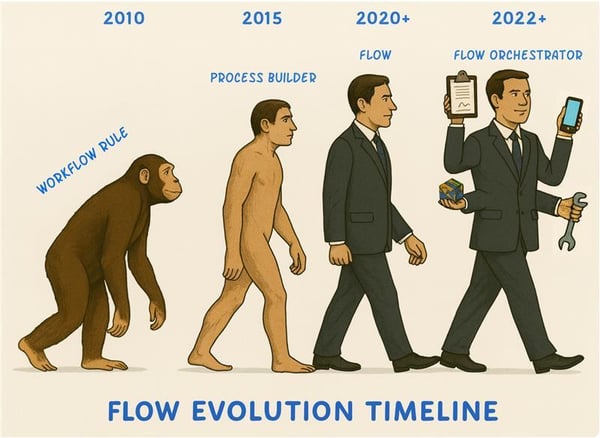
Let’s break down Salesforce’s announcement without the corporate jargon:
Workflow Rules and Process Builder will no longer be supported after December 31, 2025.
They’ll still run… until something breaks. Then you're on your own. Salesforce won't fix bugs, enhance features, or guarantee compatibility with future releases.
Also, Admins and Developers fluent in these tools are disappearing faster than a donut in the break room. Legacy automations are harder to audit, harder to manage, and nearly impossible to explain when things go sideways. Having nobody on staff who knows “why” or “how” something was built is going to be a problem. Not if it’s a problem—when it’s a problem.
In short, the technology still “exists,” but the support ecosystem won’t. And that’s a risk you don’t want at the heart of your business logic.
Flow isn’t here to do what Workflow and Process Builder did. It’s here to do more—and do it better. Let’s highlight the improvements:
This isn’t just modernization. It’s optimization.

For organizations with complex, multi-step workflows that involve multiple people (and possibly a few too many email chains), Flow Orchestration is your best friend.
It’s like a project manager for your automations—minus the passive-aggressive calendar invites.
Here’s what you’re going to love:
Perfect for onboarding, case resolution, service escalations, and anywhere humans still (occasionally) need to make decisions.
| Feature | Workflow Rule | Process Builder | Flow | Flow Orchestration |
| Logic Complexity | Basic | Moderate | Advanced | Advanced & Coordinated |
| Visual Builder | ❌ | ⚠️ | ✅ | ✅ |
| User Interaction | ❌ | ⚠️ | ✅ | ✅ |
| Reusability | ⚠️ | ❌ | ✅ | ✅ |
| Performance | 🐢 Slower | 🐢 Moderate | 🚀 Fast | 🚀 Optimized |
| Integration Support | ❌ | ⚠️ | ✅ Full API | ✅ Full API |
| Long-Term Support | Ends 2025 | Ends 2025 | ✅ | ✅ |
Still holding out hope that your 42 Workflow Rules and 27 Process Builders will peacefully ride off into the sunset? Here’s why that’s risky:
Think of it this way: the longer you wait, the more effort it takes to untangle the mess later. You don’t want to be at the top of the office pool for being the first to say, “We should have done this months ago.”
The retirement of Workflow Rules and Process Builder isn’t just a technical deadline—it’s a moment to redefine your automation strategy.
With Salesforce Flow and Flow Orchestration, you get:
All with less technical debt.
The good news? You don’t have to untangle this on your own. At Ascend Technologies, we offer a structured path from “legacy chaos” to “Flow-forward future.” (Don’t you love alliteration?)
Our 4-Step Approach:
Bonus: We’ll train your team so you can maintain and extend these Flows confidently.
…before you’re forced to. This isn't just about keeping the lights on; it’s about turning your automation into a competitive advantage. Let’s build automations that scale with you, not ones you constantly patch. We’re ready when you are.
Here’s what you can do next:
Don't wait for a crisis. Let’s get proactive, get strategic—and most of all, Let’s Flow!


Salesforce, Salesforce Clouds
October 06, 2026
Read Now

Salesforce, Salesforce Clouds
October 01, 2026
Read Now

Salesforce, Salesforce Clouds
September 29, 2026
Read Now