
Salesforce, Salesforce Release Notes
Cybersecurity Awareness Month 2026: A Checklist for IT Directors Evaluating Their MSP
October 06, 2026
Read Now.svg)

September 22, 2026
.svg)
.svg)


Salesforce is no longer just a CRM. It is a deeply unified platform designed to support how modern organizations sell, service, market, operate, integrate, and collaborate. Over time, Salesforce has expanded to meet increasingly complex business needs. That expansion is powerful… but it can also be overwhelming. With so many products available, organizations are often left wondering where to start, what fits together, and which capabilities actually matter for their business today.
Choosing Salesforce products well requires more than feature comparison. It requires understanding how Salesforce products align to business maturity, operating models, and customer experience goals. This guide walks through Salesforce’s current product ecosystem, explains what each area is designed to do, and highlights when and why it makes sense to adopt it.
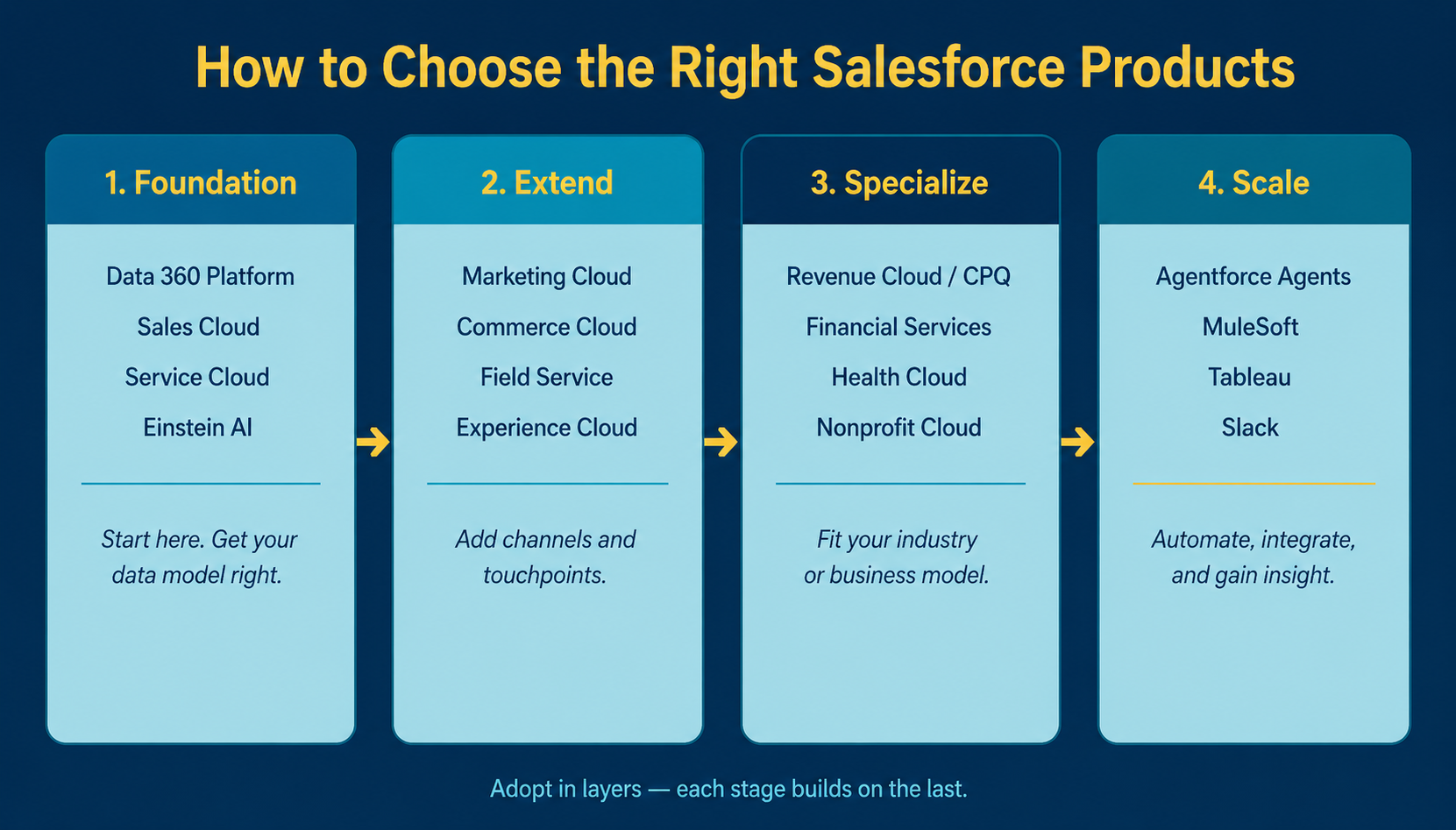
We’ve organized this guide into four adoption layers:
Foundation: Start here. Core data platform, sales, and service
Extend: Add channels: marketing, commerce, field service, portals
Specialize: Fit your industry or complex revenue model
Scale: Automate with AI agents, integrate systems, and unlock analytics
Each section describes what a product does, when it makes sense to adopt it, and what signals suggest you’re ready. You don’t need to adopt everything. You need to adopt the right things in the right order.
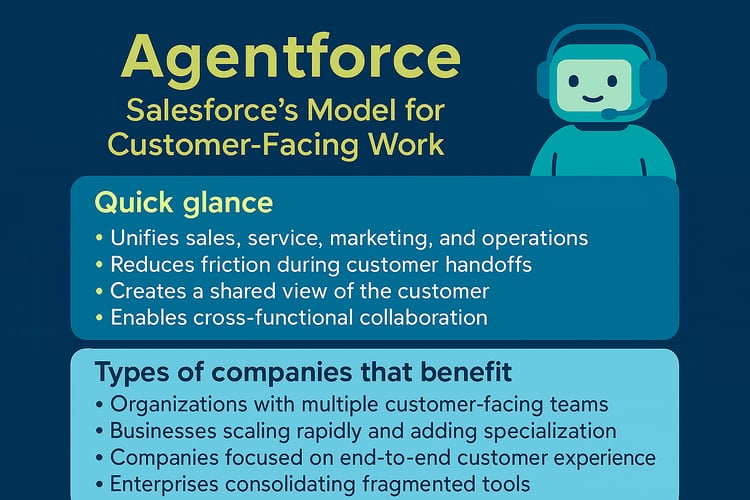
Agentforce is Salesforce’s agentic AI platform, designed to deploy autonomous AI agents that can reason, plan, and take action across customer-facing and internal workflows.
Unlike traditional automation or AI copilots that require constant human prompting, Agentforce agents operate with defined goals, trusted enterprise data, and explicit guardrails. These agents can execute multi-step processes such as resolving service requests, qualifying leads, generating quotes, or orchestrating cross-system workflows without waiting for user initiation.
Agentforce introduces a shift in how work happens inside Salesforce. AI moves from a support role to an execution role. Sales, service, marketing, and operations are no longer limited to human-driven interactions; they are augmented with digital coworkers that act directly within the flow of work. At its core, Agentforce combines:
The Atlas Reasoning Engine: Enables agents to interpret intent and determine next steps
The Einstein Trust Layer: Enforces security, privacy, and governance
Data 360 Grounding: Ensures agents act on trusted, real-time business data
Topics and Actions: Defines what agents are allowed to do and how they do it
|
✔ Best fit for: Organizations with mature data models, stable processes, and clear governance. In those environments, agents reduce manual effort, shorten execution cycles, and allow teams to focus on work that genuinely requires human judgment. Agentforce is the AI execution layer that operates across all Salesforce clouds — not a replacement for them. |
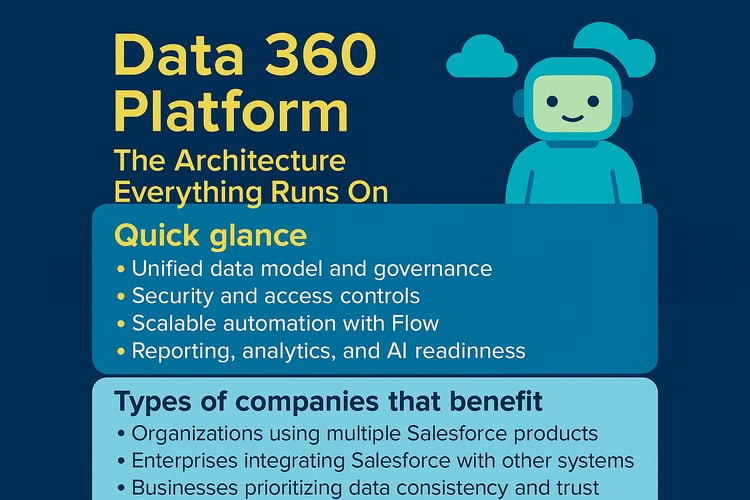
The Data 360 Platform is the foundation beneath every Salesforce product. While it receives less attention than customer-facing capabilities, it determines whether Salesforce scales cleanly or becomes brittle over time.
This platform layer governs how data is modeled, secured, automated, and extended. It includes core objects, custom data models, the Salesforce security and sharing framework, Flow automation, reporting infrastructure, and the platform services that power AI and integrations.
Every Salesforce product relies on Data 360. Weak platform decisions compound as more functionality is added. Strong platform design, on the other hand, allows organizations to layer on new products and use cases without re-architecting the core.
Data Cloud also serves as the grounding layer for Agentforce. Agents that operate on stale or incomplete data produce unreliable results. When Data Cloud is implemented well, AI capabilities become dramatically more effective.
|
✔ Start here: Invest in your data architecture before expanding to additional clouds. Organizations that get this right early experience fewer rewrites, smoother upgrades, stronger adoption, and more effective AI outcomes. |
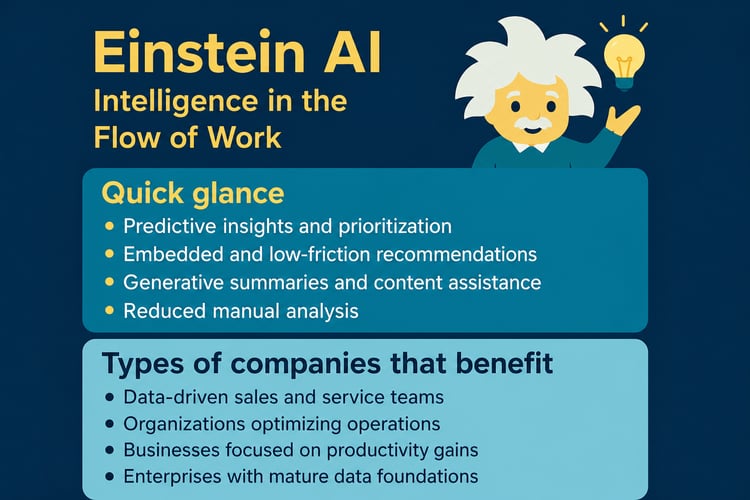
Salesforce AI, powered by Einstein, is designed to support decisions where work happens, not in separate tools or dashboards. Einstein uses Salesforce data to surface predictions, recommendations, and insights directly inside sales, service, and marketing workflows. This allows teams to prioritize actions, assess risk, and respond faster without leaving the platform.
Generative AI expands this further by helping users summarize information, draft communications, and synthesize insights. These capabilities operate within Salesforce’s data and permission model, which is critical for enterprise and regulated environments.
|
✔ Best fit for: Einstein delivers the most value when layered on top of stable processes and clean data. In those environments, AI amplifies productivity instead of creating noise. |
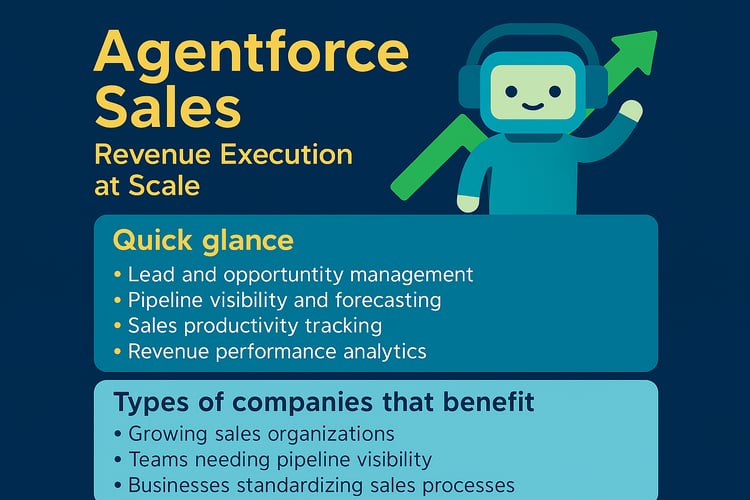
Agentforce Sales (Sales Cloud) is Salesforce’s core revenue execution engine. It manages the lifecycle from lead intake through opportunity management, forecasting, and performance analysis.
Beyond tracking deals, Agentforce Sales defines how revenue is measured and inspected. Sales stages, opportunity models, and forecasting structures all influence how leadership interprets pipeline health and risk. When designed well, it provides leadership visibility without burdening sales teams.
Agentforce Sales also serves as the primary entry point to Agentforce for most organizations. AI agents can auto-qualify leads, summarize prospect activity, draft follow-up emails, and update opportunity records — reducing administrative overhead and accelerating rep productivity.
|
✔ Best fit for: Organizations with structured sales processes, multiple reps or regions, and a need for pipeline visibility and forecasting accuracy. Agentforce Sales often serves as the foundation for broader Salesforce adoption. |
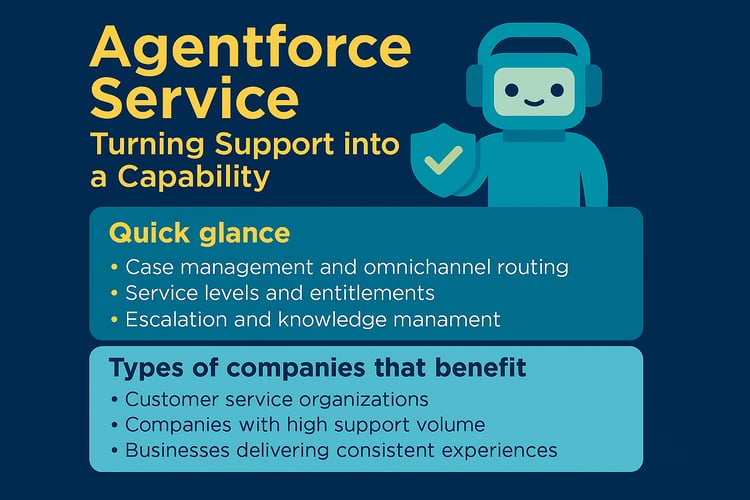
Agentforce Service supports customer service and support operations across multiple channels, including email, phone, chat, and messaging.
More than case tracking, Agentforce Service introduces operational rigor. Routing, SLAs, entitlements, escalation rules, and knowledge management help organizations deliver consistent and measurable service.
As service organizations mature, Agentforce Service becomes a source of insight by identifying trends, surfacing common issues, and informing upstream improvements to products and processes.
|
✔ Best fit for: Any organization with a customer-facing support function. Most effective when Service and Sales share a unified data model, eliminating the need for agents to toggle between systems. |
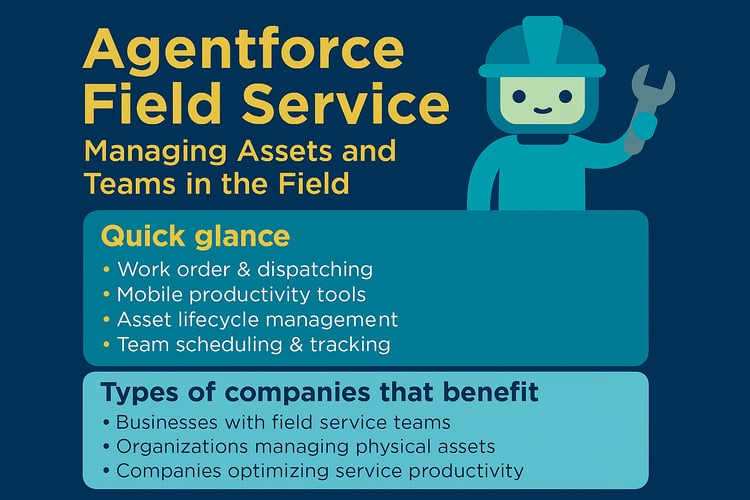
Agentforce Field Service extends Salesforce into the physical world, supporting organizations that deliver on-site or location-based service.
It manages scheduling, dispatch, technician workflows, asset history, and mobile execution. These capabilities bring structure and visibility to operations that are traditionally difficult to coordinate.
Field Service is especially valuable where geography, timing, and resource availability introduce complexity. Salesforce becomes the system that orchestrates people and assets while maintaining full customer context.
|
✔ Best fit for: Utilities, manufacturing, healthcare, and facilities organizations with field technician teams. Most effective when connected directly to Service Cloud for a seamless customer-to-field workflow. |
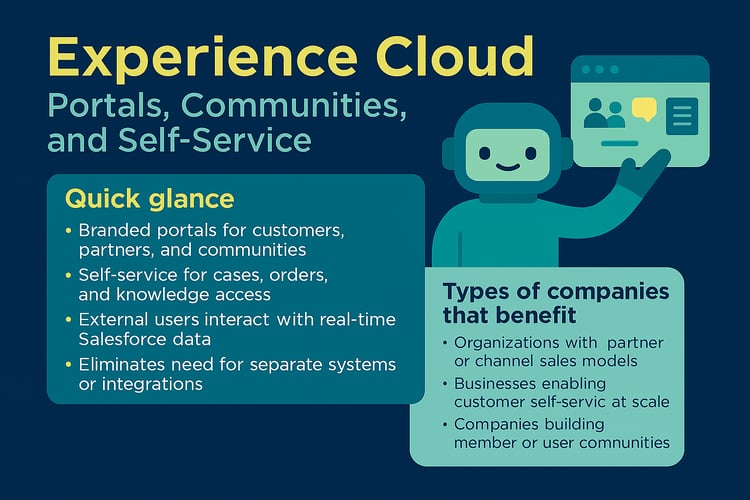
Experience Cloud is one of the most frequently overlooked Salesforce products — and one of the most versatile. It enables organizations to build branded digital experiences that expose Salesforce data and functionality to external audiences: customers, partners, dealers, agents, and communities.
Common use cases include self-service portals (where customers can log cases, check order status, or access knowledge articles), partner portals (where channel partners manage deals, register leads, or access training), and community hubs (where members engage with content and each other).
Because Experience Cloud sits on the Salesforce platform, external users interact with the same data that internal teams work with — without requiring custom integrations or separate systems. A customer who submits a case through a self-service portal creates a record that service agents see immediately.
|
✔ Best fit for: Organizations with partner channels, customer self-service needs, or member communities. Experience Cloud dramatically reduces the cost and complexity of extending Salesforce to external stakeholders. |
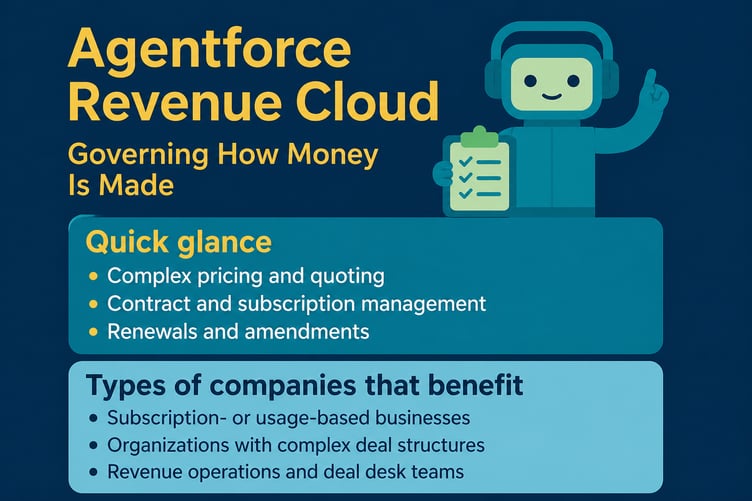
Revenue Cloud (including Salesforce CPQ (Configure, Price, Quote) and Billing) supports organizations with complex revenue models that extend beyond simple opportunity close-won transactions.
This product area manages pricing logic, quoting, approvals, contracts, subscriptions, renewals, and amendments. It aligns commercial intent with operational reality, ensuring that what is sold is what is contracted, billed, and renewed correctly.
Revenue Cloud becomes critical as deal structures grow more customized. Manual quoting processes introduce pricing errors, slow deal velocity, and create misalignment between sales and finance. Revenue Cloud brings control, consistency, and scalability to these workflows.
|
✔ Best fit for: Organizations with product bundles, volume-based pricing, subscription models, or complex approval workflows. Often adopted when sales and finance realize their systems must operate in tighter alignment. |
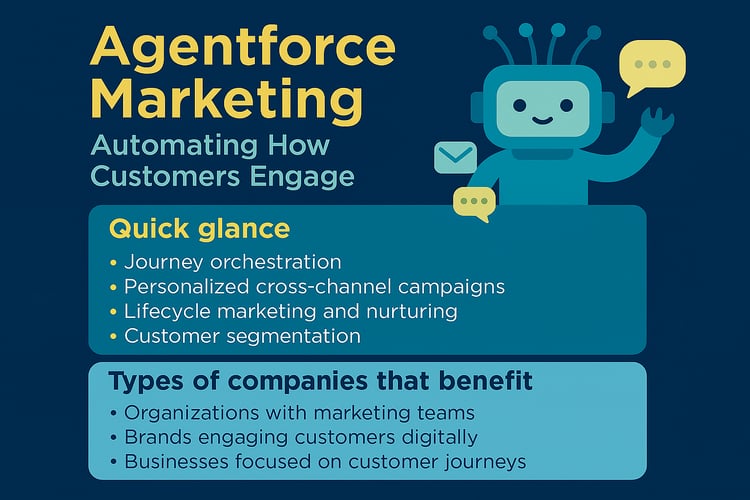
Marketing Cloud represents Salesforce’s marketing ecosystem, but its real purpose is often misunderstood. These products are not simply about sending emails or launching campaigns — they are about coordinating customer engagement over time, across channels, and in alignment with sales and service. Salesforce intentionally split marketing into multiple platforms because marketing maturity varies widely:
Marketing Cloud Engagement: Large-scale, multi-channel journey orchestration (consumer-focused)
Account Engagement (Formerly Pardot): B2B lead and account nurturing, tightly integrated with Sales Cloud
Marketing Cloud Personalization: Real-time behavioral responsiveness and 1:1 content targeting
Marketing Cloud Intelligence: Cross-channel analytics and media spend optimization
Together, these platforms allow marketing teams to move beyond campaigns and toward lifecycle-based engagement aligned with the full customer journey.
|
✔ Best fit for: Most valuable when integrated with the broader Salesforce ecosystem. Marketing Cloud without Sales Cloud integration limits visibility into pipeline impact. With integration, marketing becomes a measurable contributor to revenue. |
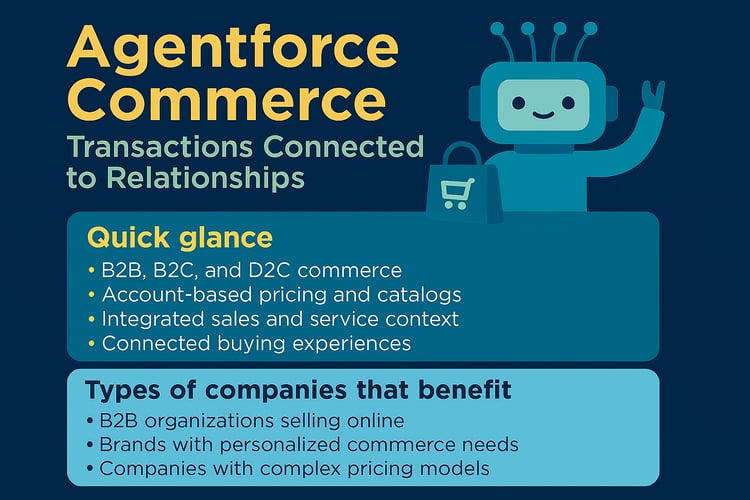
Agentforce Commerce is Salesforce’s commerce platform, but its defining feature is not checkout or catalogs; it is context. Traditional commerce platforms treat transactions as isolated events. Salesforce approaches commerce as one moment in a longer customer relationship. Pricing, availability, service history, contracts, and entitlements all influence the buying experience.
Agentforce Commerce supports B2C, B2B, and direct-to-consumer models, but it becomes especially valuable when pricing is dynamic, products are bundled, or buyers are already known entities within Salesforce. For B2B organizations, this often means supporting negotiated pricing, contract-based purchases, reorders, and account-specific catalogs.
|
✔ Best fit for: Organizations where buying and selling are not purely anonymous or transactional. When Commerce is connected to Sales and Service Cloud, a customer’s order history is immediately visible to account teams and service agents without switching systems. |
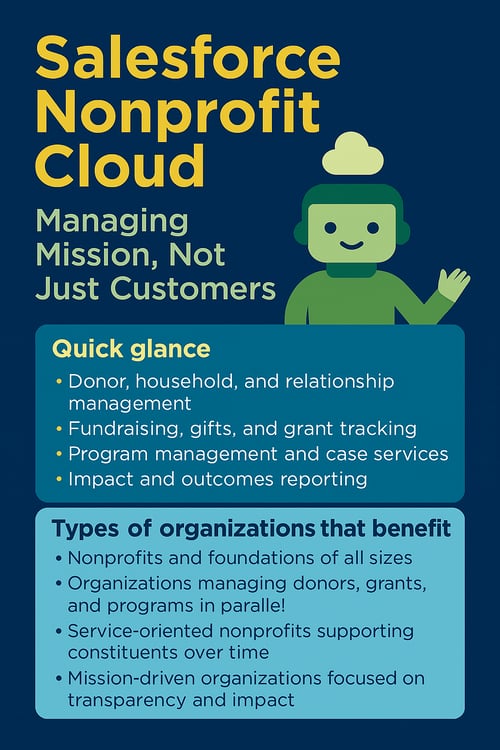
Salesforce Nonprofit Cloud is Salesforce’s platform designed specifically for mission-driven organizations. While nonprofits share many operational needs with for-profit businesses, they also operate with fundamentally different goals, funding models, and success measures. Nonprofit Cloud reflects that reality.
Rather than centering solely on revenue and transactions, Nonprofit Cloud is built to manage relationships, impact, and trust across donors, constituents, volunteers, programs, and partners. It supports fundraising, grant management, program delivery, outcomes tracking, and case management within a unified data model.
Nonprofit Cloud brings together capabilities that previously lived across separate tools: donor and household management, fundraising and gift processing, grant tracking, program enrollment, service delivery, and impact measurement. These functions operate on the same Salesforce platform as Sales, Service, Marketing, and Data 360, allowing nonprofits to scale without losing transparency or control.
As nonprofit organizations grow, spreadsheets and disconnected systems quickly become limiting. Reporting becomes fragmented, donor engagement becomes harder to personalize, and operational insight suffers. Nonprofit Cloud introduces structure while remaining flexible enough to support diverse missions and operating models.
|
✔ Best fit for: 501(c)(3) organizations, foundations, and mission-driven entities that need to manage donor relationships, program outcomes, and grants within a single platform. When implemented thoughtfully, Nonprofit Cloud enables organizations to spend less time managing data and more time advancing their mission. |
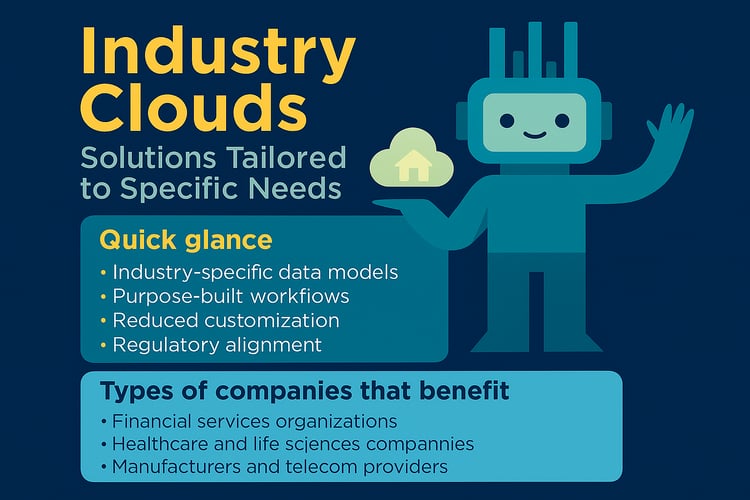
Salesforce Industry Clouds exist because some industries operate with domain complexity that generic data models cannot easily support.
Financial Services Cloud (FSC), for example, fundamentally reshapes the Salesforce data model around households, financial accounts, goals, and life events. This mirrors how financial institutions actually operate — rather than forcing advisors and relationship managers into a contact-centric CRM structure built for generic B2B sales. Other industry clouds do something similar, introducing domain-specific objects, terminology, workflows, and pre-built best practices:
Health Cloud: Care coordination, patient relationships, and clinical workflows
Manufacturing Cloud: Account-based forecasting, run-rate agreements, and partner management
Communications Cloud: Subscription billing, order management, and customer lifecycle for telecom
Public Sector Solutions: Grant management, licensing, inspections, and constituent services
The value of industry solutions is not just faster implementation — it is alignment. Salesforce fits the business model instead of the business bending to the tool. This is especially important in regulated environments where reporting, data structure, and auditability are non-negotiable.
|
✔ Best fit for: Organizations in regulated or complex industries willing to adopt standard industry patterns rather than reinvent everything from scratch. The ROI on industry clouds comes from what you don’t have to build. |
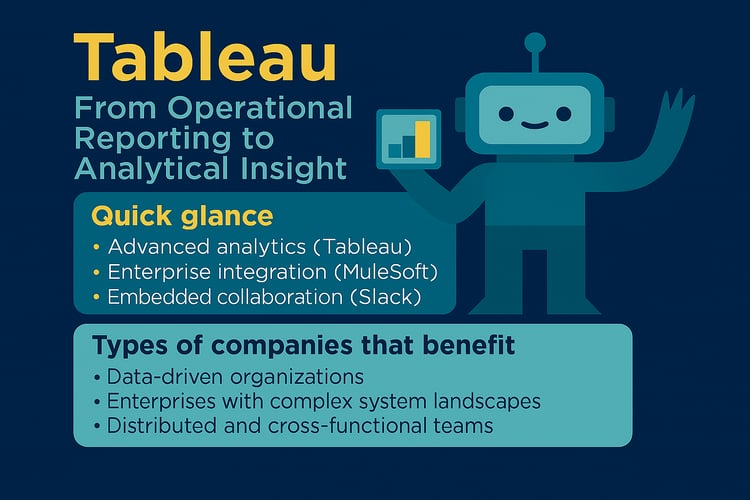
Tableau extends Salesforce beyond operational reporting into full-scale analytics and business intelligence. Salesforce reports are excellent for day-to-day operational insight: pipeline, case metrics, campaign performance. Tableau comes into play when organizations want to explore data, identify trends, and ask questions that were not predefined during implementation.
Tableau excels at visual storytelling. It allows analysts and business users to blend Salesforce data with external data sources, create interactive dashboards, and uncover patterns that inform strategic decisions. Tableau is not limited to CRM data; it becomes a central analytics layer across the business.
In mature Salesforce environments, Tableau often supports executive dashboards, cross-system analytics, and advanced exploration that would be difficult or impractical inside standard CRM reporting.
|
✔ Best fit for: Organizations with reporting needs that span multiple data sources or that require strategic, exploratory analysis beyond CRM metrics. Most valuable when a dedicated analytics owner can drive adoption and maintain dashboards. |
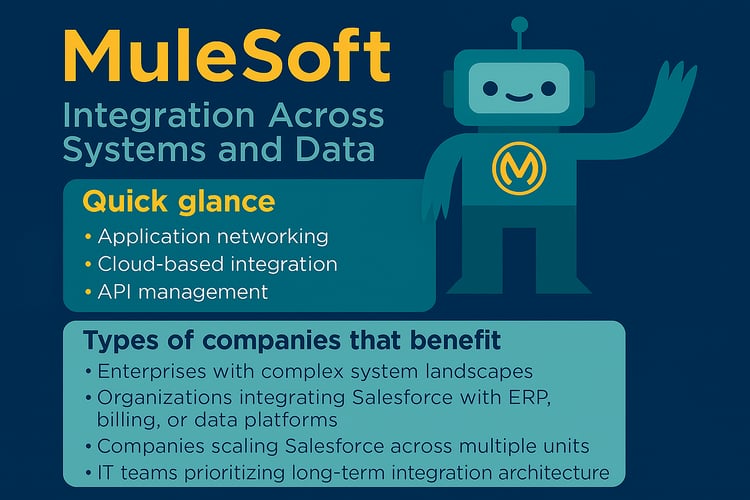
MuleSoft addresses one of the most consistent realities of enterprise technology: Salesforce rarely exists alone.
Most organizations use ERP systems, data warehouses, industry platforms, legacy systems, and third-party applications that must exchange data with Salesforce. MuleSoft provides an API led integration approach that makes those connections scalable and maintainable.
Rather than building point-to-point integrations that are difficult to manage, MuleSoft encourages reusable APIs that decouple systems from one another. This allows Salesforce to evolve without constantly re-engineering integrations, and it supports real-time or event-driven data flows where needed.
MuleSoft also powers Agentforce integrations — enabling AI agents to act across systems, not just within Salesforce. An agent that needs to look up an ERP order, trigger a billing event, or write to a downstream system can do so through MuleSoft-managed APIs.
|
✔ Best fit for: Organizations where business-critical processes depend on consistent data movement between Salesforce and other enterprise systems. MuleSoft becomes essential as Salesforce adoption expands across departments. |
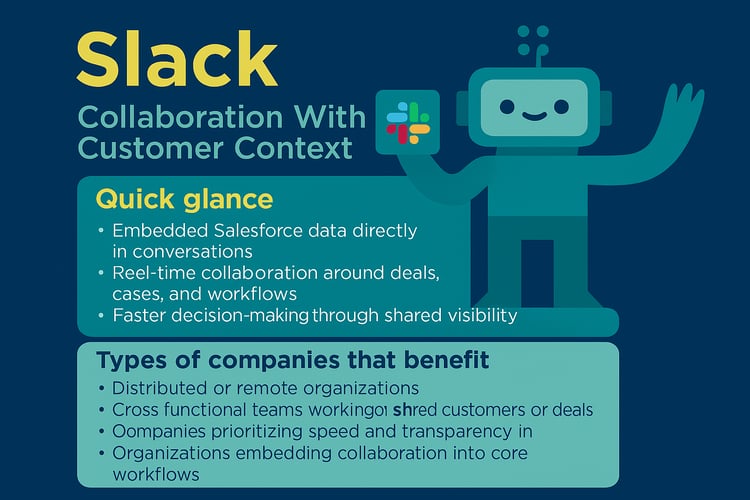
Slack is not just messaging layered onto Salesforce. Its value comes from embedding Salesforce data directly into daily collaboration.
When integrated well, Slack channels become extensions of business processes. Deal reviews, service escalations, approvals, and cross-functional collaboration happen with real-time Salesforce context directly in the conversation.
Slack reduces the need for status meetings and email threads by making work visible and collaborative. It is especially powerful in fast-moving environments where decisions need to be made quickly and with shared information.
|
✔ Best fit for: Organizations embracing async communication and cross-functional collaboration. Impact grows as Salesforce data is embedded into channels where teams already spend their time. |
Salesforce’s ecosystem is powerful because it is unified, but that power only delivers value when products are chosen intentionally and aligned to business needs. The most effective Salesforce implementations we’ve seen share a few things in common: they start with a strong data foundation, they adopt products in logical sequence, they invest in governance early, and they treat Salesforce as a strategic platform rather than a collection of tools.
The organizations that struggle are those that adopt too much too fast, underinvest in platform architecture, or choose products based on features alone rather than business fit.
As a Salesforce preferred partner, we help organizations evaluate where they are today, where they want to go, and which Salesforce products support that journey. When implemented with a clear strategy, Salesforce becomes more than software...it becomes a foundation for long-term growth.
Connect with us on LinkedIn, X, and Facebook, or schedule a consultation to talk through what's worth prioritizing for your setup.


Salesforce, Salesforce Release Notes
October 06, 2026
Read Now

Salesforce, Salesforce Release Notes
October 01, 2026
Read Now

Salesforce, Salesforce Release Notes
September 29, 2026
Read Now