
Salesforce, Salesforce Tips and Tricks
What Auditors Check First: Five Domains You Can Test This Week
October 28, 2026
Read Now

November 23, 2026



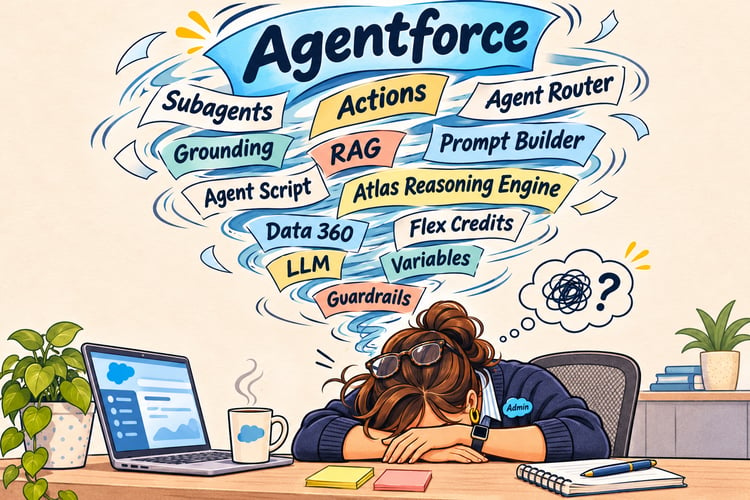
You open an Agentforce tutorial, and it tells you to create a topic. You open your org, and the builder says subagent. Then someone mentions grounding, a retriever, and hybrid reasoning, and suddenly the conversation needs its own glossary.
Let’s connect those terms to something familiar. A customer asks, “Where’s my order?” An Agentforce solution can identify the request, retrieve the right order, and respond with the shipping status. Your team decides which information it can access, which tasks it can perform, and when a person needs to take over.
That’s the foundation. The terminology starts making more sense when you can see what each piece contributes.
Agentforce is Salesforce’s platform for building and deploying AI agents. An agent can interpret a request, choose from the capabilities you give it, and perform work using business data. Depending on the solution, it might assist an employee inside Salesforce or handle a customer conversation through a supported channel.
“Autonomous” means it can take steps within the boundaries you configure. You still define its responsibilities, give it access to data and actions, and test whether it handles the work correctly.
For a first solution, I’d look for a frequent request with a clear outcome and information your team already trusts. That gives you something specific to build and measure. A few avenues to explore include the following:
These are solution directions. The template, channel, underlying automation, permissions, and licensing determine what you can deliver in a particular org. For example, an appointment-booking experience needs an action connected to the scheduling system. Describing that task in an instruction is only part of the configuration.
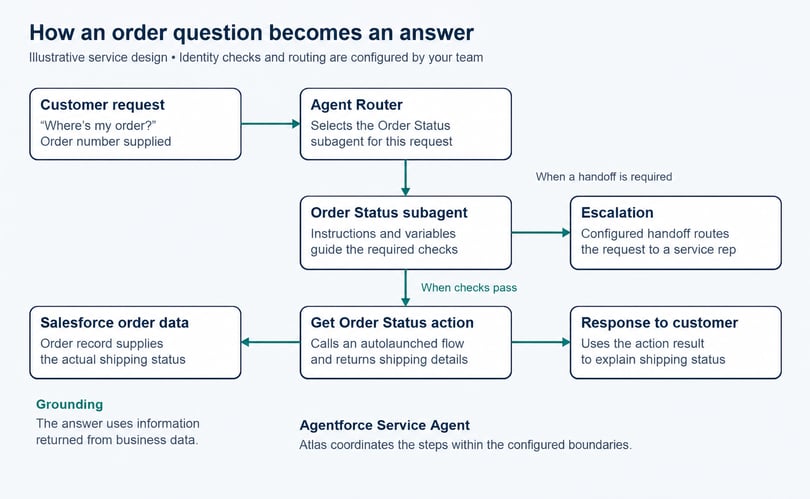
Imagine a service agent configured to handle order-status questions. The customer provides an order number. The agent routes the request to the appropriate subagent, follows the required identity checks, and uses an action to retrieve the order. It can then use that result in its response.
The visual shows one possible design, including a route to a service rep when the configured conditions require a handoff.
Agent and Agent Type
The agent is the configured solution doing the work. An agent type determines important aspects of its intended use and supported experiences. Agentforce Service Agent and Agentforce Employee Agent are examples.
An agent template gives you a starting configuration for a use case. You still review the included capabilities and adapt them to your process. Choosing a template is the beginning of the implementation.
Subagent and Agent Router
A subagent defines a particular job within an agent, with instructions and actions for that job. In our example, Order Status could be one subagent and Returns another.
The Agent Router is the starting subagent in the current builder. It helps select which subagent should handle the request. Clear descriptions matter because the system needs to distinguish the jobs available to it. “Check an existing order’s shipping status” gives it a more specific responsibility than “Help Customers.”
If you see Topic or Topic Selector in an older article, those labels became subagent and Agent Router beginning in April 2026. Keep that translation handy when following tutorials.
Action and Reference Action
An action gives an agent a specific capability, such as looking up an order or creating a case. A standard action is supplied by Salesforce. A custom action connects the agent to functionality for your business.
The reference action is the underlying functionality being called. For example, “Get Order Status” could be an agent action backed by an autolaunched flow. The flow performs the lookup and returns the result.
Inputs are the values the action needs, such as an order number. Outputs are the values it returns, such as shipping status and tracking number. Give those values clear descriptions so the agent can use them appropriately.
For admins, this is a practical connection to Flow. Review an existing flow’s inputs, outputs, access settings, and error handling before making it available to an agent.
Instructions and Variables
Instructions guide the agent’s behavior. They can describe the job, how to communicate, what information to gather, and when to escalate.
A variable stores a value the agent can use during the interaction. Our order-status example might store the order number, the result of an identity check, and the shipping status. Those values can inform later steps and reduce repeated questions.
I’d write instructions around observable behavior. “Ask for the order number before retrieving shipping details” gives you something you can test. “Provide great customer service” leaves much more open to interpretation.
Large Language Model and Reasoning Engine
A large language model, or LLM, processes language and generates responses. It helps the agent interpret a request such as “Has my package left yet?”
The Atlas Reasoning Engine coordinates how the agent uses its instructions, subagents, and actions to work through that request. It can determine that more information is needed, select an available action, and use the result to continue.
Agent Script and Hybrid Reasoning
Agent Script is the language used to define agent behavior in the current Agentforce Builder. It brings natural-language instructions together with expressions for business logic, variables, and transitions.
Hybrid Reasoning combines model-driven decisions with explicitly defined logic. For example, the model can interpret a customer’s wording while a configured condition controls whether an order lookup becomes available.
That matters when a business rule needs consistent enforcement. Put the required identity check into the actual logic and action design, then test the allowed and blocked paths. Salesforce’s language supports those controls. Choosing which rules to enforce is part of your solution design.
Prompt and Prompt Template
A prompt is the input sent to a model. It can include instructions, the user’s request, and relevant business information.
A prompt template is a reusable definition that adds business data when it runs. Prompt Builder is Salesforce’s tool for creating these templates. An example is a template that generates a case summary from selected case information. An agent action can also call a prompt template.
Grounding and Hallucination
Grounding means supplying relevant information so the model has a factual basis for its response. Retrieving the actual shipping status grounds the order answer in business data.
A hallucination is an incorrect or unsupported AI-generated response. Grounding improves the information available to the model. You still need to test whether it uses that information correctly, especially when a record is missing or a policy is unclear.
RAG and Agentforce Data Library
Retrieval-augmented generation, usually shortened to RAG, is a form of grounding. The system retrieves relevant content and adds it to the information used to generate a response. A returns-policy question might retrieve the relevant section of an approved article.
An Agentforce Data Library makes configured content available for grounding, including Knowledge content or uploaded files. Salesforce requires Data 360 to be set up for this feature, and data libraries consume Data 360 credits. Older documentation calls Data 360 Data Cloud.
For current web information, check the supported setup carefully. Salesforce directs new implementations to the Search the Web standard action for agents. Its setup documentation says web search is unsupported for new data libraries.
Chunking and Retriever
Chunking splits larger content into smaller sections for retrieval. A search index organizes that content for searching, and a retriever defines how relevant information is selected at runtime.
Why should an admin care? If the return deadline and its exceptions get separated, the retrieved passage may leave out the condition that changes the answer. Content structure affects the response your customer receives.
A citation links an answer to supporting content. It helps the reader inspect the source behind a response.
Agentforce Studio and Agentforce Builder
Agentforce Studio brings together tools for building, testing, and monitoring agents. Agentforce Builder is where you configure an individual agent. The current builder offers Canvas and Script views. Older articles may show the legacy builder inside Setup, so check which experience a tutorial covers before following its steps.
Agent User and Guardrails
An agent user is a Salesforce user identity whose permissions help determine what the agent can access and do. Most employee agents run in the logged-in user’s context. Many customer-facing agents use a configured agent user.
Review the execution context and the underlying action’s access behavior together. A flow or Apex implementation brings its own security considerations.
Guardrails are controls that constrain behavior, including permissions, eligibility conditions, instructions, and escalation rules. The Einstein Trust Layer provides platform safeguards, with feature-specific behavior. Salesforce documents that pattern-based and field-based LLM data masking are disabled for agents, including prompt templates invoked through agent actions. That detail matters when reviewing sensitive information.
Channel and Escalation
A channel is where someone interacts with the agent, such as a supported messaging experience. A connection contains the configuration for connecting the agent to that channel.
Escalation hands the conversation to a person when the configured process calls for it. An Omni-Channel flow can route that conversation to the appropriate service team. Define what information the person needs when taking over, so the customer can continue from the work already completed.
Testing Center and Observability
An utterance is something a user says or types. Testing Center evaluates sets of test cases to assess things such as subagent selection, actions, and response quality.
In Builder, Simulate checks behavior using simulated execution. Live Test runs actions and can change org data. I’d use controlled test records in a sandbox for that stage.
Observability covers monitoring and investigation after interactions occur. Traces help you examine what happened during a particular request.
Flex Credits and Digital Wallet
Flex Credits are a consumption unit for eligible Agentforce usage. Digital Wallet helps track consumption. The usage type and current rate card determine how activity translates into credits. Testing can also be metered, so include it in your estimate alongside production usage.
A connected subagent is a separately configured agent that an orchestrator agent can call to delegate work. Multi-agent orchestration coordinates those agents. You may also hear the coordinating agent called a Super Agent.
For a first order-status solution, I’d keep the scope small enough to explain in one sentence. Add another agent when a distinct responsibility needs its own configuration, data access, and testing. That gives the business a concrete decision to make about expanding the solution.
Before you build, write down the request you want to handle, the information needed to answer it, the actions allowed, and the point where a person takes over. Then use this cheat sheet to translate those decisions into the Agentforce configuration.
Connect with us on LinkedIn, X, and Facebook, or schedule a consultation to talk through what's worth prioritizing for your setup.
Written by Jennie Kennedy


Salesforce, Salesforce Tips and Tricks
October 28, 2026
Read Now

Salesforce, Salesforce Tips and Tricks
October 22, 2026
Read Now

Salesforce, Salesforce Tips and Tricks
October 20, 2026
Read Now