
Salesforce, Salesforce Release Notes
Cybersecurity Awareness Month 2026: A Checklist for IT Directors Evaluating Their MSP
October 06, 2026
Read Now

September 29, 2026



Let’s start with the uncomfortable truth: most Salesforce adoption problems aren’t actually Salesforce problems.
They're process problems. UX problems. Trust problems.
They come from workflows that don’t match reality, automations that feel punitive, and page layouts that require a scavenger hunt just to log a call. When users avoid Salesforce, it usually isn’t rebellion. It’s resistance to unnecessary effort.
You can mandate usage. You can threaten reporting gaps. You can even bribe people with gift cards. But if the system doesn’t help users do their jobs faster, easier, or more confidently, adoption will always be fragile.
Strong Salesforce adoption usually comes down to four things:
If Salesforce feels slower than spreadsheets, side notes, or Slack messages, users will avoid it. The easier it is to complete real work in Salesforce, the more naturally adoption happens.
Users need confidence that the data is accurate, current, and useful. The moment teams stop trusting reports or forecasts, they create parallel systems outside Salesforce.
Modern adoption isn’t just about the Salesforce UI. It’s about bringing Salesforce capabilities into the tools users already live in, like email, Teams, Slack, and internal systems.
Users adopt systems that help them succeed. When automation removes repetitive work, dashboards answer real questions, and feedback turns into improvements, Salesforce stops feeling administrative and starts feeling operational. Organizations with the strongest adoption don’t simply enforce Salesforce usage. They design experiences that make Salesforce the easiest and most valuable way to work.
Before jumping into solutions, let’s define the goal. Salesforce adoption is not:
Salesforce adoption is:
If users only use Salesforce because they're forced to, you don't have adoption. You have compliance. And compliance breaks the moment someone finds a workaround.
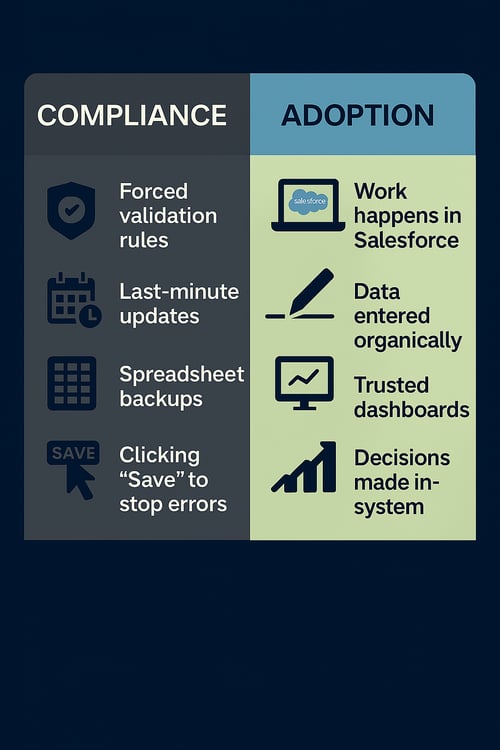
Training matters. But it’s rarely the main issue. Low adoption almost always shows up when Salesforce feels like extra work. Most often, that’s caused by:
Users don't resist Salesforce because they dislike technology. They resist it because it slows them down. The goal is simple: make Salesforce the easiest place to get real work done.
One of the most common mistakes we see is designing Salesforce from the top down. Leadership wants reporting. Operations want consistency. Finance wants clean stages. All of that matters, but none of it works if users struggle to do the work that produces the data. Adoption improves when designs start with real user moments:
This is where smart Lightning page design pays dividends:
If Salesforce feels obvious, users stop thinking about it and start using it.
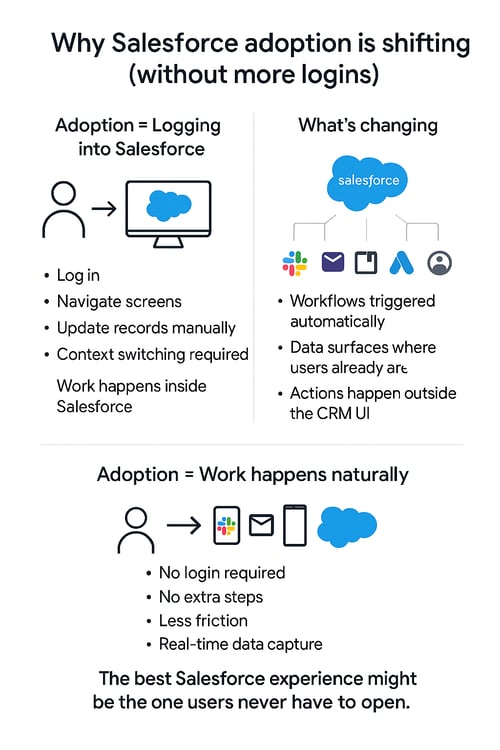
There’s also a broader shift happening: users don’t always need to log into Salesforce at all. With more API-first and composable patterns, Salesforce data and actions can live directly inside the tools people already use like email, Slack, Teams, or internal apps.
This is where modern Salesforce strategy is evolving. Instead of forcing users into another system, organizations are embedding Salesforce capabilities directly into existing workflows. The less users have to context switch, the more naturally adoption happens.
In many cases, improving Salesforce adoption isn't about improving the Salesforce UI. It's about reducing the need to open Salesforce in the first place.
Validation rules are one of the fastest ways to damage user trust when overused. Overuse them, and users learn to game the system. You’ll see rushed updates, placeholder data, and last-minute compliance that helps no one. A better pattern is progressive guidance:
A simple check helps here: Is this rule helping the user succeed or just protecting the report? If it’s the latter, the timing is probably wrong.
Nothing improves adoption faster than removing low-value admin work. If users are updating stages after deals already moved forward, manually creating repetitive follow-up tasks, or entering the same data in multiple places, Salesforce isn’t helping them. It’s slowing them down. High-impact automation patterns include:
When automation feels like an assistant, not a supervisor, users lean in instead of opting out.
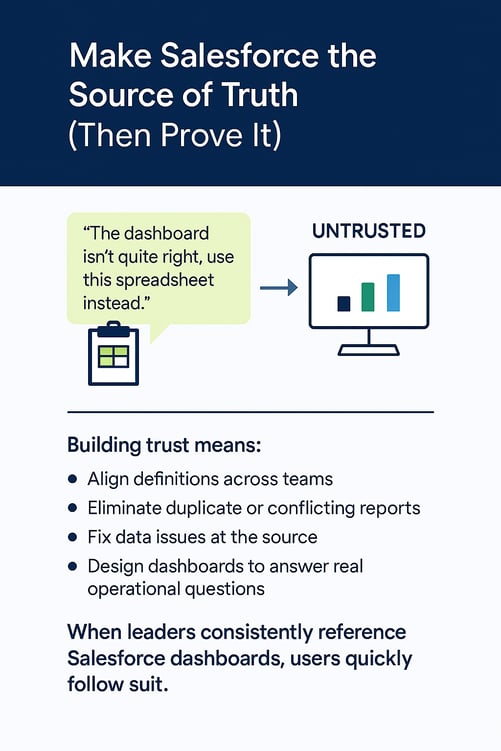
Adoption doesn’t fail when users stop logging in. It fails when they stop trusting the data. The moment someone says, “Let’s just use the spreadsheet instead,” Salesforce has already lost its role as the source of truth. And the real danger isn't bad data alone; it's the creation of parallel systems. The second teams start maintaining their “real numbers” somewhere outside Salesforce, reporting credibility begins collapsing across the organization. Rebuilding trust requires consistency:
Trust also comes from visibility. When leadership relies on Salesforce data in meetings, forecast reviews, and decision-making — and does so consistently — users notice. The system becomes operationally important instead of administratively required.
Because ultimately, people don’t adopt systems they distrust. They adopt systems that help them make better decisions with confidence. When Salesforce becomes the place where the business actually runs, adoption stops feeling forced and starts becoming natural.
One quiet adoption killer is ignored feedback. Users stop caring when they feel unheard. Fixing this isn’t about saying yes to everything, it’s about visibility. What works:
Even small visible improvements build momentum. When users see feedback turn into action, they stop viewing Salesforce as something being imposed on them and start viewing it as a system evolving with them. People support what they feel ownership in.
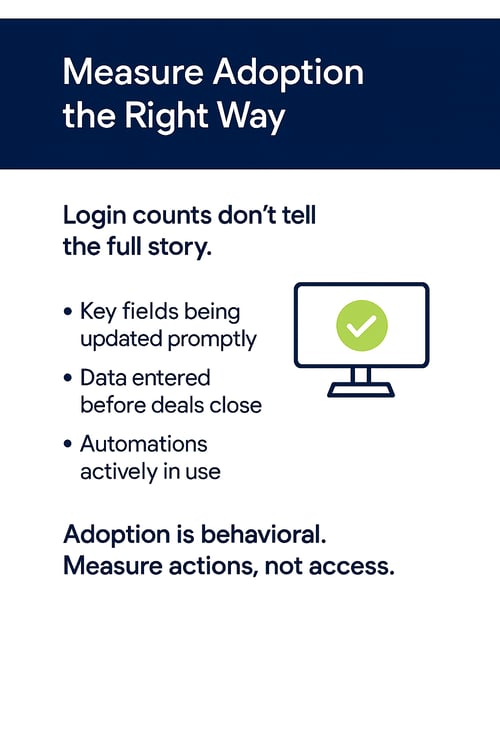
Login activity might be easy to track, but it rarely reflects real usage. If users are only opening Salesforce to check a box, or right before a meeting, you’re not seeing true adoption. A better way to measure it:
Real adoption shows up in how people work, not how often they log in. If the right actions are happening at the right time, adoption is there, whether users notice it or not. Strong adoption metrics measure behavioral alignment, not just platform activity.
Sometimes low adoption isn't failure; it's feedback. It’s Salesforce signaling that the process is off, the flow doesn’t match reality and/or the system needs to evolve. The strongest Salesforce orgs aren’t the ones with the strictest rules. They’re the ones that keep adjusting as the business changes. Mature organizations treat adoption issues as operational signals, not user failures.
We once worked with a sales team that technically used Salesforce every day and still didn’t trust it.
Opportunities lived in the system, but stages were always behind reality. Tasks were created inconsistently. Reps tracked their real work in notes, emails, or spreadsheets, then “caught Salesforce up” before leadership meetings. On paper, adoption looked fine. In practice, nothing happened in real time. The instinctive response would’ve been more training or stricter rules. Instead, we changed the design. We rebuilt the Opportunity experience around how reps actually worked:
No new dashboards. No added validation rules. No extra clicks. Within a few weeks, something shifted. Stages started reflecting reality. Forecast calls got shorter. Managers stopped asking for “offline updates.” Not because users were told to adopt Salesforce, but because Salesforce finally started helping them sell. That’s what real adoption looks like.
You don’t increase Salesforce adoption by telling users to try harder. You increase it by designing with empathy, automating with intention, enforcing rules at the right moment, and proving value consistently. When Salesforce genuinely makes work easier, adoption stops being something you chase and starts being something you get for free.
If Salesforce adoption is lagging in your org, the problem is almost never effort. It is design. We help teams audit their Salesforce org the way users experience it. Where friction creeps in. Where automation helps or hurts. Where processes quietly push people back to spreadsheets. In a short working discovery session, we’ll:
No pressure. No generic best practices. Just a clear, honest assessment of what’s helping adoption and what’s quietly killing it.


Salesforce, Salesforce Release Notes
October 06, 2026
Read Now

Salesforce, Salesforce Release Notes
October 01, 2026
Read Now

Salesforce, Salesforce Release Notes
September 24, 2026
Read Now